
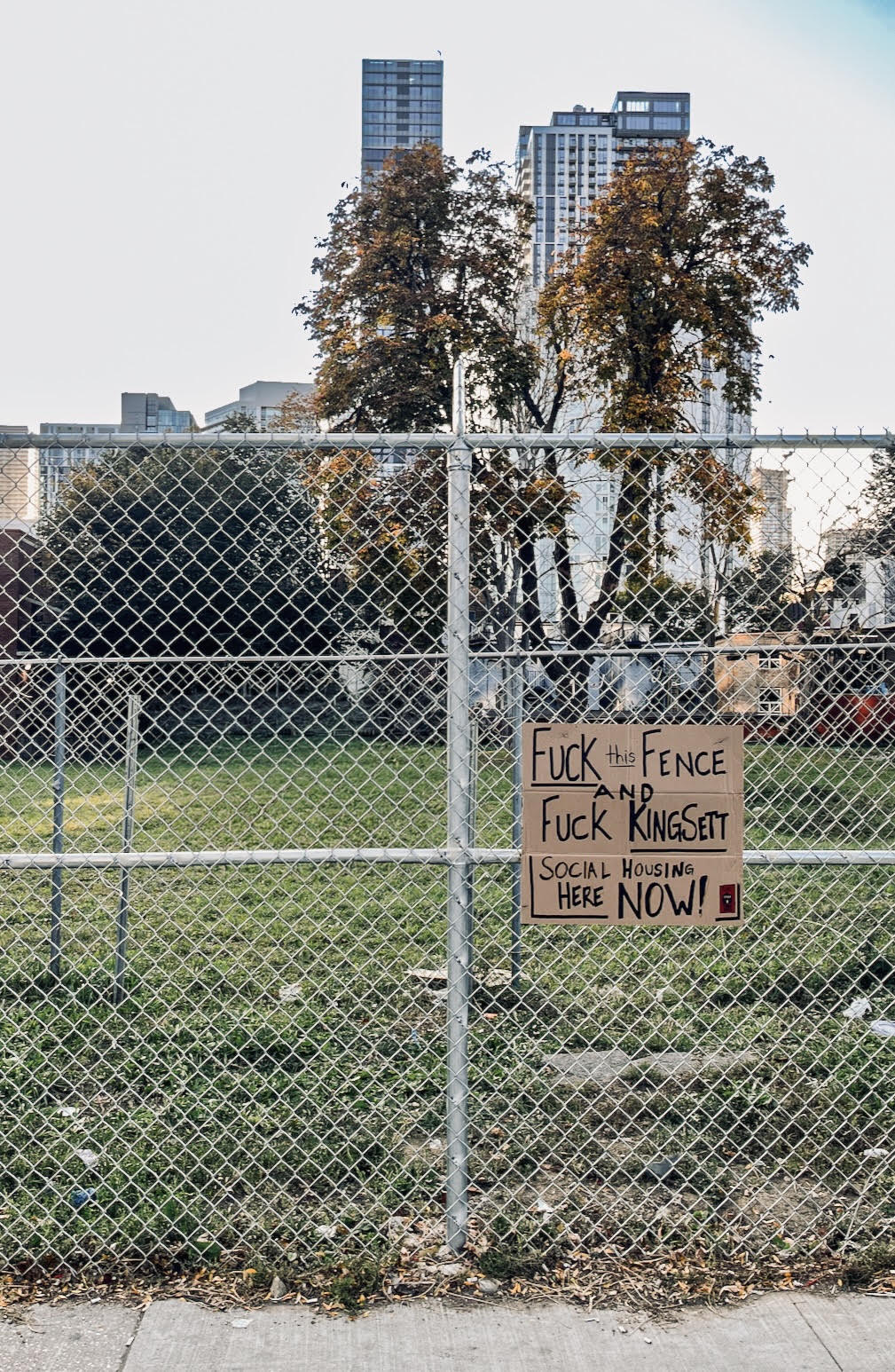
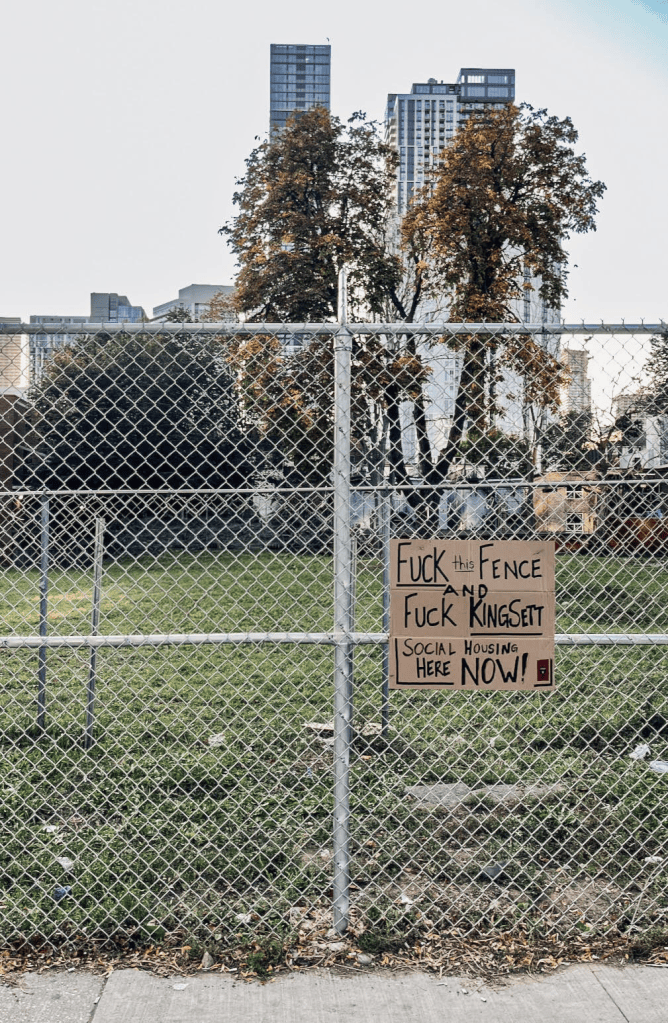
On October 30, members of 230 Fightback received written confirmation from Toronto By-Law that the fortified fence located at 214-230 Sherbourne Street was indeed illegal. For two months the 8-foot fence, complete with barbed wire, had intimidated community inhabitants and everyday users of the adjacent space. The superfluous fence was erected on August 19 by KingSett Capital, the self-proclaimed national leading private equity real estate investment firm, in response to a growing encampment adjacent the original legal chain link fence.
Bought in 2022 by KingSett for speculative purposes, 214-230 Sherbourne has been latent and enclosed from community use for nearly 20 years. Long identified as a strategic and an ideal location for the construction of much needed deeply affordable housing by community activists, agencies, and municipal staff alike, the illegal fence is symbolic for the gentrification and displacement devastating Toronto’s downtown east. But city hall’s continued complicit endorsement of speculative real estate development and paramount observation of private property rights above the needs of all citizens reproduces the very scaffold which propagates the area’s unremitting violent affordability crisis.
In early September a member of 230 Fightback had contacted Toronto’s 311 to make a formal complaint about the barbed wire and general encroachment which the fence posed upon the community and public realm. While the much under resourced Toronto By-Law had given 230 the estimate of inspecting the fence within a week, that was eventually pushed back to the end of September, and ultimately not acted upon until October 29, after the community had taken matters into their own hands.
The Reclaim Our Corner event/action (in collaboration with TUHU and the All Saints Church) took place on October 14 and saw members of 230 in concert with the community hung photos of inhabitants who use the area’s social services. The photo exhibit consisted of a gallery of 23 portraits and quotes of what securing housing would mean or has meant, as well as 11 enlargements of previous posters that 230 Fightback had used in their fight for social housing at the site. This aesthetic occupation of the fence was done to make visible people who had been categorized and made invisible while they waited the upwards of 17 years for municipal housing and navigating the throes of Toronto’s underfunded social services. The photo exhibit, which was a visual stride towards the reclamation of the Dundas corner for the area’s working class and homeless, was respected and well received by the community. But apparently the gallery was in bad taste to the landowner who had the photo’s removed from the fence within 48 hours of their
hanging.
The early morning of October 21, 230 Fightback began to remove the abhorrent fence as roughly 35 allies and community members came and supported the action. Surprised that no one came to stop them, members of 230 were able to remove the illegal barbed wire and entire chain-link fencing within an hour and a half before any police presence arrived. Once what stood a disgusting emblem of speculative real estate had been reduced to the frame of a broken system while inviting community members to use the exposed land as they saw fit. The actions taken by 230 Fightback the morning of October 21 was but another moment along a long history of fence removal and community resistance to displacement and community alienation in the downtown east. But unsurprisingly, 230 received word by community members that KingSett had replaced the fence’s chain link on October 27. But the barbed wire remained down.
A maximum fine of $100,000 could have been issued to the fence’s owner if members of 230 and their allies had not ironically removed and cut down the barbed-wire and fence days prior to by-law inspection. KingSett’s obscene fence would have been found in violation of § 447-1.2. of Toronto’s Municipal Code, which cites prohibited fences, and explicitly states: “No barbed wire, chicken wire or other barbed or sharp material shall be used in any fence unless the fence is permitted by Subsection B ….” (p. 447-3 – 447-4). The subsequent section requires a fence in exemption of municipal standards to have received written permission from council and a visible permit displayed at the site of the fence, neither of which, one may assume, KingSett had or exhibited.
Moving forward 230 Fightback will once again continue voicing concern and disdain to this blatant placement of capital above human need and private property over common ownership. We invite the newly elected Ward 13 councillor Curran Stikuts to join our cause and continue the fight for much needed social housing from within the halls of the state.
We Will Not Be Pushed Out!
This fight for social housing in Toronto’s downtown east will continue!

